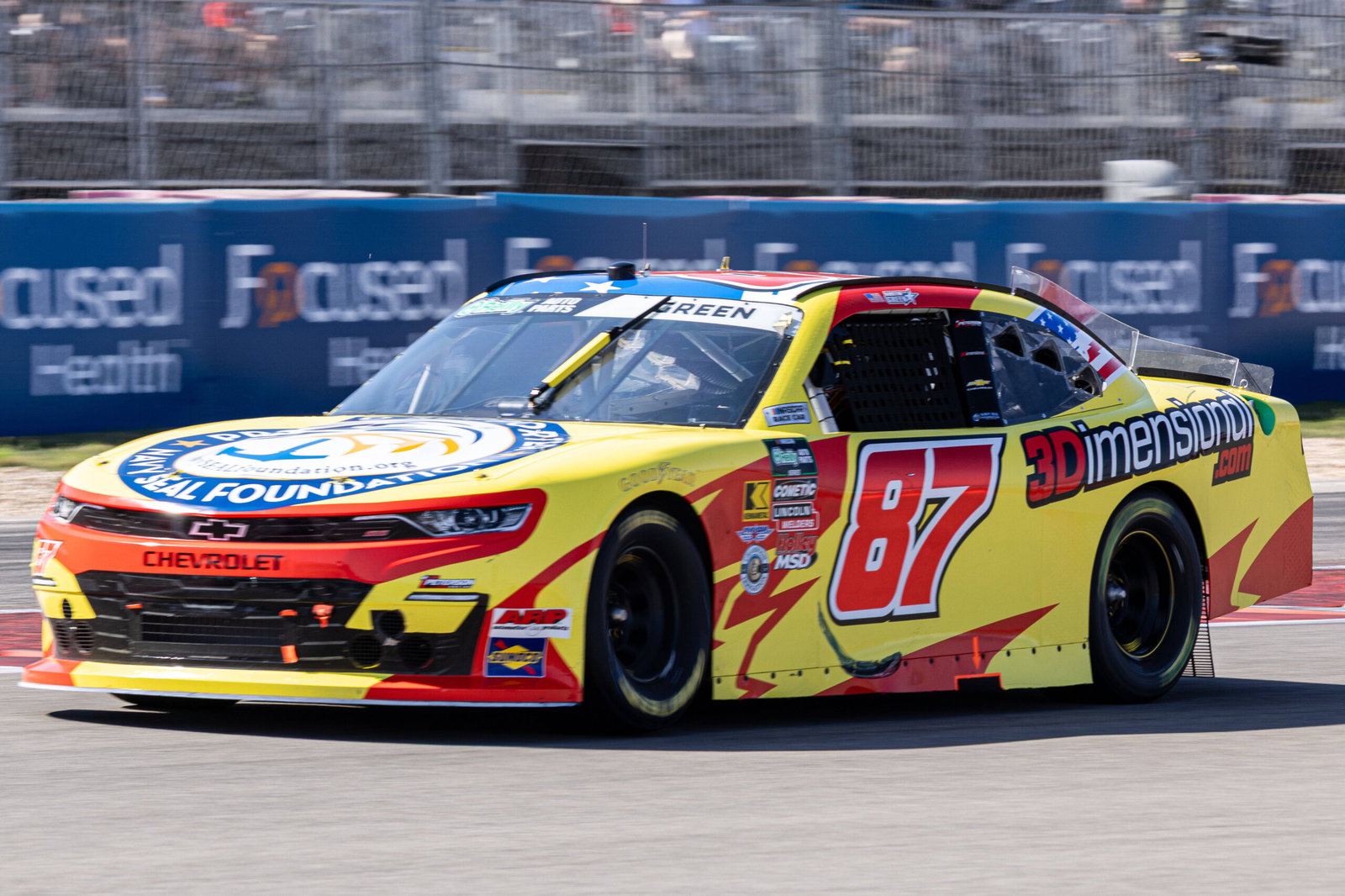
February 28, 2026, Austin, Texas, U.S: Austin Green 87 in action during the NASCAR, Motorsport, USA OÃââ Reilly Auto Parts Series race, the Focused Health 250, at the Circuit of the Americas racetrack in Austin, Texas. Austin U.S - ZUMAw300 20260228_zaf_w300_020 Copyright: xDanxWozniakx
February 28, 2026, Austin, Texas, U.S: Austin Green 87 in action during the NASCAR, Motorsport, USA OÃââ Reilly Auto Parts Series race, the Focused Health 250, at the Circuit of the Americas racetrack in Austin, Texas. Austin U.S - ZUMAw300 20260228_zaf_w300_020 Copyright: xDanxWozniakx
May 8, 2026, 10:10 AM CUT
Austin Green Leaning on RCR Alliance in Rookie O’Reilly Campaign
Austin Green faces a unique challenge as his 2026 NASCAR O’Reilly Auto Parts campaign hinges upon how Peterson Racing learns from its technical alliance with RCR. This plays a pivotal role as Green looks to race at tracks where he is a novice, and the team, as well, lacks experience.
Peterson Racing entered the season with just three full-time employees. But the minute they witnessed excellence in execution, they expanded operations. The team is now committed to a complete national schedule with the No. 87 Chevrolet and now has 22 prepared chassis.
As they rely on RCR for data learning, simulation support, and engineering guidance, the results are following. Take, for example, Talladega, where Green led his first O'Reilly laps before finishing 10th, his best oval result in the series.
Despite carrying a 27.1 average finish entering Watkins Glen, Green admitted the No. 87 has consistently shown top-15 speed before. This is despite his not having driven on nearly half of the opening 12 tracks on the 2026 schedule before entering practice.
It is at such times that he relies on simulator runs for experience and RCR drivers Austin Hill and Jesse Love for advice.
Austin Green has earned eight top-10 finishes in three years, including a runner-up result to Connor Zilisch at the 2025 Charlotte Roval. However, his first season with Peterson Racing hasn't gone as well. However, the team believes Watkins Glen could realistically produce a top-five run for the No. 87 Chevrolet.
The braking weapon Austin Green brings from Trans-Am to Watkins Glen
Austin Green’s Trans-Am TA2 experience is exactly what makes him a secret weapon at Watkins Glen. The reason is that TA2 cars teach drivers to brake very late while keeping the car on track and balanced.
These beasts have V8 engines, steel brakes, manual shifting, and extremely low grip compared to NASCAR cars. So drivers can’t just depend on downforce to help them turn. Trail braking, a technique used by drivers where braking continues into the corner, is commonly used in TA2.
This has made Austin Green learn how to brake late and exit corners with more speed while ensuring he doesn't make contact with rivals around.
Speaking about this edge on road courses, he said, "It’s a confidence boost knowing you can go and run well. What is tough now is there used to be such a wide spread. Now, everyone is getting closer. At COTA, I felt like everyone was pretty tough. There are a lot more road courses than there used to be back in the day, so you have to be good and versatile."
At Watkins Glen, drivers must slow down from almost 180 mph into Turn 1 and brake hard again entering the Inner Loop chicane later in the lap. Green’s braking style helps the car rotate faster through corners and lets him get back on the throttle earlier.
Now, with RCR helping Peterson Racing fine-tune its brakes, dampers, and suspension, combined with Green’s braking edge, could strike gold at Watkins Glen this weekend.
Read more at the RFK Racing Digest!
Written by

Uday Jakhar
Edited by

Yask Kotak