
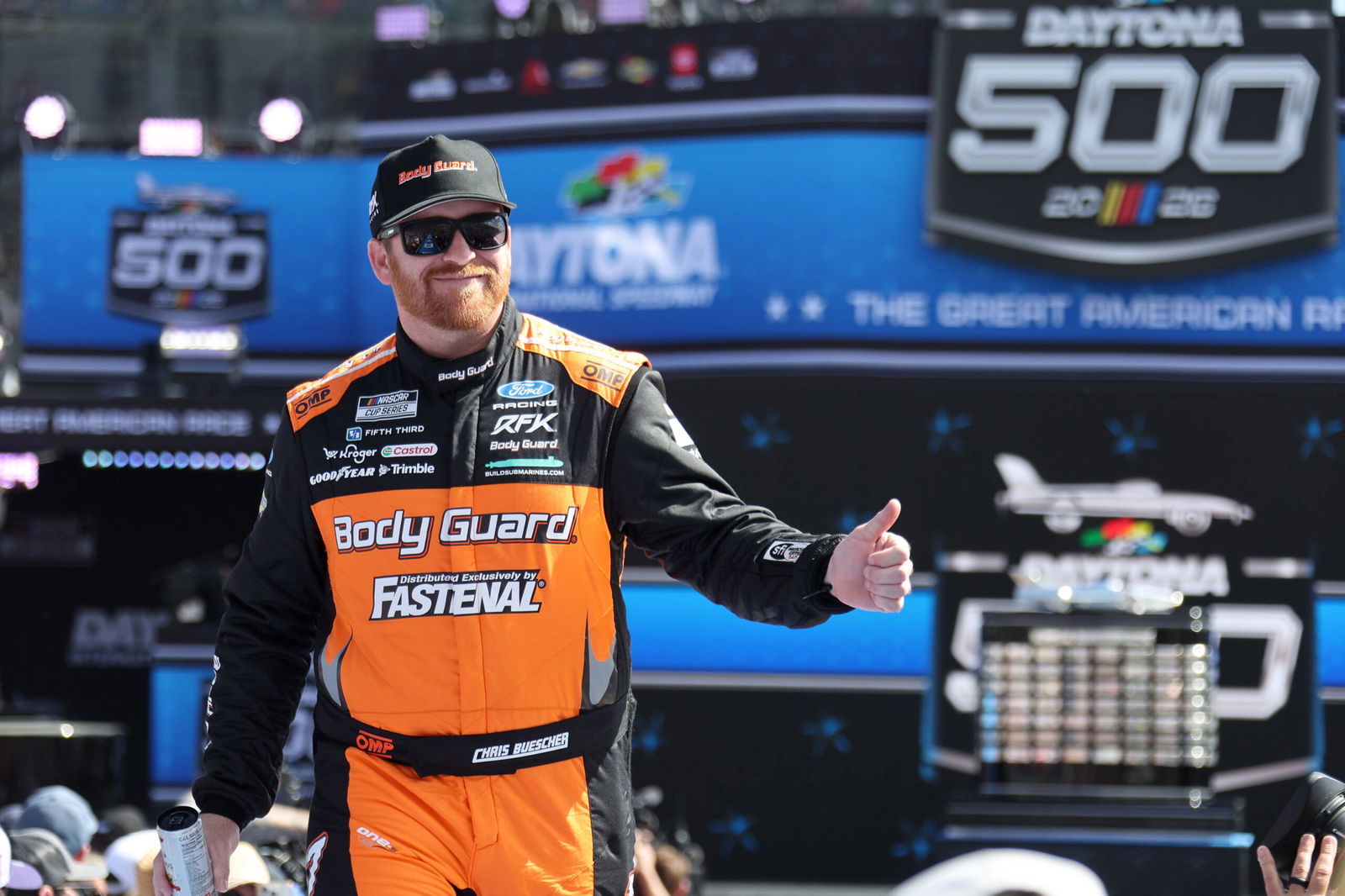
DAYTONA BEACH, FL - FEBRUARY 15: Chris Buescher 17 RFK Racing Body Guard Ford waves to the crowd prior to the running of the 68th NASCAR, Motorsport, USA Cup Series Daytona 500 on February 15, 2026 at Daytona International Speedway in Daytona Beach, FL. Photo by Jeff Robinson/Icon Sportswire AUTO: FEB 15 NASCAR Cup Series Daytona 500 EDITORIAL USE ONLY Icon260215946500
DAYTONA BEACH, FL - FEBRUARY 15: Chris Buescher 17 RFK Racing Body Guard Ford waves to the crowd prior to the running of the 68th NASCAR, Motorsport, USA Cup Series Daytona 500 on February 15, 2026 at Daytona International Speedway in Daytona Beach, FL. Photo by Jeff Robinson/Icon Sportswire AUTO: FEB 15 NASCAR Cup Series Daytona 500 EDITORIAL USE ONLY Icon260215946500
May 3, 2026, 5:36 PM CUT
Chris Buescher Eyes First Texas Top-10 After 16-Race Drought
Chris Buescher arrives at Texas Motor Speedway with one of the most inconsistent racing records in the NASCAR Cup Series you can imagine. Across 16 starts at his 1.5-mile Fort Worth oval home track, he has failed to register a single top-10 finish, with an average result of 21.9 and just two laps led out of more than 5,000 completed.
For a driver currently running inside the top tier of the 2026 standings and consistently producing top-10 pace elsewhere, this cannot be deemed to be a deficiency of speed or skill.
Instead, we can term it as track-specific anomalies where compounding variables have a strong effect, at times, outweighing the skills and ability that this brilliant driver possesses. This variation has also been attributed by Buescher to the Next Gen car, combined with the uncertainties of Texas Motor Speedway.
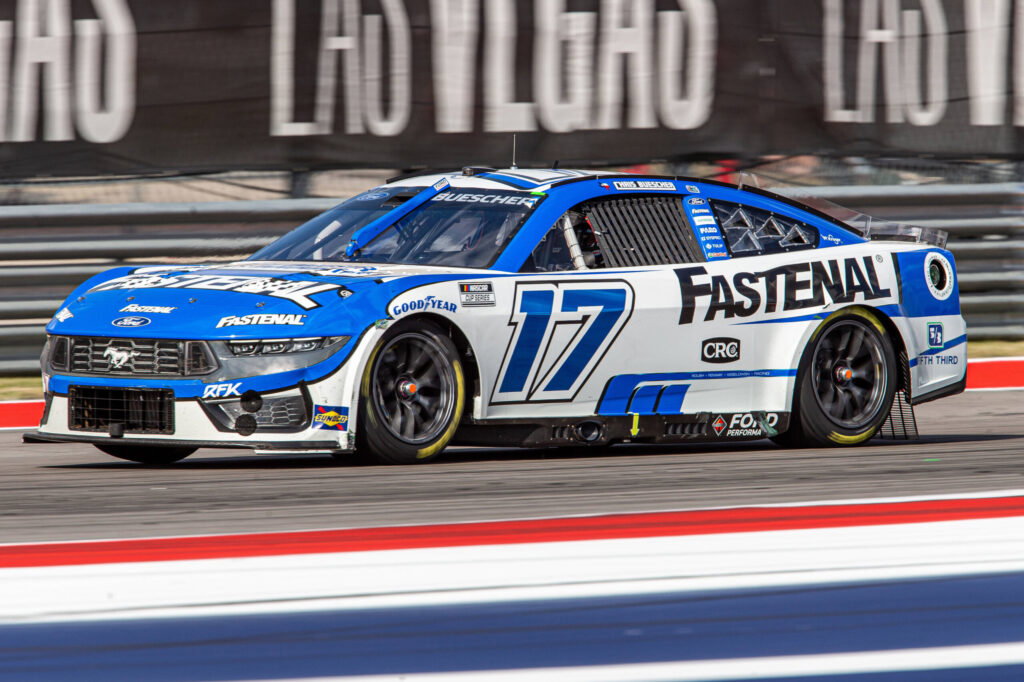
March 2, 2025, Austin, Texas, U.S: NASCAR, Motorsport, USA Cup Series driver Chris Buescher 17 in action during the Nascar Cup Series, EchoPark Automotive Grand Prix race, at the Circuit of the Americas racetrack in Austin, Texas. Austin U.S - ZUMAw300 20250302_zaf_w300_037 Copyright: xDanxWozniakx
March 2, 2025, Austin, Texas, U.S: NASCAR, Motorsport, USA Cup Series driver Chris Buescher 17 in action during the Nascar Cup Series, EchoPark Automotive Grand Prix race, at the Circuit of the Americas racetrack in Austin, Texas. Austin U.S - ZUMAw300 20250302_zaf_w300_037 Copyright: xDanxWozniakx
Buescher has explicitly identified the venue as his most problematic for tire failures, particularly during the early adaptation phase of the Next Gen car, where stiffer construction and load sensitivity amplified blowout risks.
“We’ve had more tire failures here than any other race track,” Buescher said. “Early on, we came here and had speed, but we were still understanding the new (Gen 7) car, the sensitivities to having tire blowouts."
Add to this the track’s identity. Texas, since 2022, has been known to provide the highest average cautions per race, frequent strategy disruptions, and extremely tight racing grooves that severely penalize even minor execution errors.
The 2026 season, however, seems to be aligning well for Buescher. He is now placed inside the top tier of the season, with multiple top-10 finishes in the opening races, an average finish near the top-10 threshold, and a front-row-adjacent starting position that directly challenges his earlier critique of track position sensitivity.
Add to this, Buescher has qualified third for the Texas Cup race after the front row was locked by Spire drivers.
Additionally, improved track understanding and better strategy by RFK Racing, and he is now adapting well to the Next Gen platform, allowing him to mitigate those variables that had earlier worked against him. Which is why, this time, he has a good chance of finally finishing under the top-10 if not winning it.
These variables do not just affect Buescher but everyone on the grid and have now become challenges for several teams to encounter.
The Texas variance that everyone fears
Texas Motor Speedway is the variable king of all racetracks, where race outcomes are often dominated by interruption frequency rather than continuous performance.
In the Next Gen era, the track has averaged around 14 cautions per race, the highest across the Cup Series calendar, with recent events consistently exceeding 11 cautions and late-stage clustering of yellow flags. This splits the race into fragments, resulting in finishing position distributions shifting from fast lap times to severely restart-dependent, multi-modal outcomes.
Another high-influence issue is that with such frequent stoppages, the pit strategy is often thrown out of the window. Normally, teams plan their race around fuel windows of about 55–65 laps and manage tire wear over time. But in Texas, unexpected cautions keep interrupting these plans.
If a caution comes during pit stops, it creates an uneven situation: cars that haven’t pitted yet suddenly gain track position, while those that already pitted can lose laps. This means that the final position would largely depend on when a caution happens. Adding to that, the rough surface of the track increases stress on tires, thereby increasing the frequency of such failures.
Towards the end of the race, these issues become even more extreme. The above point regarding results being dependent more on restart position than lap time is exemplified further when we note that many Texas races finish with very short green-flag runs, sometimes just a few laps.
Thus, even though for drivers and teams Texas may present itself as a headache or a challenge that always has new variables, for racing fans it stands as the epitome of American racing, combining chance with raw speed in a way few tracks can.
Read more at the RFK Racing Digest!
Written by

Uday Jakhar
Edited by

Suyashdeep Sason