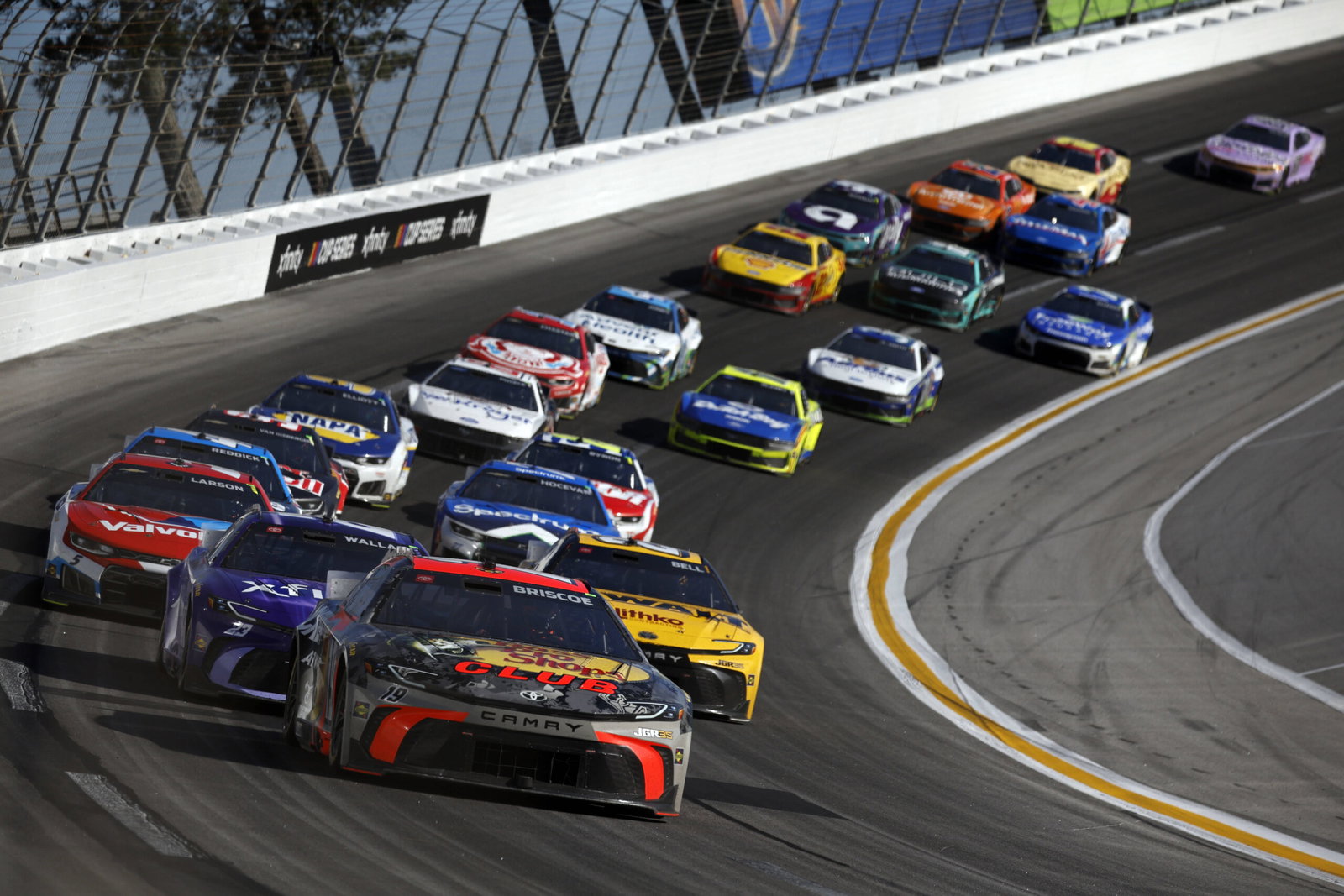
February 22, 2026, Hampton, Ga, USA: CHASE BRISCOE 19 of Mitchell, IN races through the field for The Autotrader 400 at EchoPark Speedway in Hampton, GA. Hampton USA - ZUMAa161 20260222_aaa_a161_017 Copyright: xWalterxG.xArcexSr.x
February 22, 2026, Hampton, Ga, USA: CHASE BRISCOE 19 of Mitchell, IN races through the field for The Autotrader 400 at EchoPark Speedway in Hampton, GA. Hampton USA - ZUMAa161 20260222_aaa_a161_017 Copyright: xWalterxG.xArcexSr.x
Apr 15, 2026, 3:34 AM CUT
NASCAR Boss Admits TV Played Key Role in Fan-Hated Decision
Sage from GTA SA wasn’t wrong when she said we are constantly getting bombarded by ads, and that’s from a game based in 1992! It’s not hard to believe the same logic applies in the modern-day NASCAR landscape, especially when it comes to one of its most debated introductions: stage breaks.
In Tuesday's episode of the "Door Bumper Clear" podcast, NASCAR President Steve O’Donnell spoke about the evolution of commercials in the sport and the need for stage breaks. He began by expressing frustration over the previous format, which irked fans, saying:
"If you ask about race control when I was up there, the reason why I probably got kicked out is because I would go absolutely crazy when a caution came out, and we're just running laps. It's driving me crazy. If you ask John Probst, if a red flag came out, I would say every television in America just turned off. And so, our job is always to speed it up."
"But if you go back to when I first came up in racing, right, we went away for commercial. Racing was going on, but nobody saw anything," he added.

October 18, 2025, Lincoln, Al, USA: AUSTIN HILL 21 wins the United Rentals 250 in Lincoln, AL. Lincoln USA - ZUMAa161 20251018_aaa_a161_091 Copyright: xWalterxG.xArcexSr.x
October 18, 2025, Lincoln, Al, USA: AUSTIN HILL 21 wins the United Rentals 250 in Lincoln, AL. Lincoln USA - ZUMAa161 20251018_aaa_a161_091 Copyright: xWalterxG.xArcexSr.x
O'Donnell then explained that NASCAR introduced stage breaks so that television networks had a dedicated space to broadcast their commercials, thereby balancing the entertainment and economy side of things. The addition of picture-in-picture view during later stages also helps, but stage breaks remain the primary source of media revenue.
"We introduced the stage break so that TV could kind of load up their commercials. We saw that worked pretty well. Now we have some side-by-side racing, which is good," he said.
O’Donnell acknowledged the duration of stage breaks, an issue that needs to be looked into.
"The next thing to work on is the length of those stage breaks, because especially at short tracks, you know, I've heard, 'Get rid of the actual break and just run it.' When we did that at the road courses, getting a small sample size, it was terrible. But we're still looking at it, and I think you know the drivers are pretty loud."
However, the NASCAR President emphasized that the officiants are not intentionally extending stoppage time for added media revenue.
The introduction of stage breaks remains a divisive topic. Purists often say that it disrupts the natural flow of the race and therefore hampers the viewership. The viewership concern, specifically, has also been echoed by Denny Hamlin.
Denny Hamlin is against the "brutal" TV experience for fans
On the "Actions Detrimental " podcast, JGR driver and 23XI co-owner Denny Hamlin spoke about how his experience of watching the O’Reilly Auto Parts race at Martinsville was hampered due to the caution lengths being too long.
He called out what he claims are greedy tactics hurting the fan experience by prolonging caution periods for commercial breaks. Hamlin felt that this was the result of the business pressure. Advertisers have to ensure ROI on their costs to NASCAR for broadcasting their commercials.
While this is understandable, the extended caution periods make viewers jump to other channels during that period.
“These companies are paying big money to NASCAR to broadcast these," said Hamlin. "They're going to make sure they get a proper return on investment, and to get that, they need to have commercials. Got to have people buying those commercials. It's hurting the watching experience because it’s just brutal."
"I'm bouncing between basketball and O'Reilly's, and it's just that I find myself, it's hard for me to stay on the NASCAR channel," the JGR driver concluded.
Written by

Aaradhya Singh
Edited by

Yask Kotak